SOAP Notes with AI: Examples and Templates for 10 Specialties
On this page
- SOAP notes in 60 seconds
- What an AI scribe changes, and what it doesn’t
- How to read the examples
- 1. Family medicine SOAP note example
- 2. Urgent care SOAP note example
- 3. Cardiology SOAP note example
- 4. Neurology SOAP note example
- 5. Physical therapy SOAP note example
- 6. Podiatry SOAP note example
- 7. Psychiatry / therapy SOAP note example
- 8. Pediatrics SOAP note example
- 9. Dermatology SOAP note example
- 10. Orthopedics SOAP note example
- How to build a SOAP note template that works with AI
- Tips for better AI-generated SOAP notes
- FAQ
- What is a SOAP note?
- Can AI write SOAP notes?
- Are AI-generated SOAP notes accurate?
- Can I use the same SOAP template for every specialty?
- Does Chartnote support formats other than SOAP?
- Try AI SOAP notes on your next visit
The SOAP format is simple. Writing a good SOAP note 25 times a day, while staying on time and actually listening to patients, is not.
That’s where AI scribes help. An ambient scribe listens to the visit and drafts the Subjective, Objective, Assessment, and Plan for you to review. But “good” looks different in a podiatry clinic than in a therapy practice, so the template behind the note matters as much as the AI.
Below is a short SOAP primer, then a fictional example for each of 10 specialties, with tips for building a template that fits.
Important: every patient, finding, and plan below is fictional and for illustration only. None of it is real patient data, and none of it is clinical guidance. Always document what actually happened in your visit.
SOAP notes in 60 seconds
According to StatPearls, the four headings of a SOAP note are Subjective, Objective, Assessment, and Plan. Here’s what each usually holds:
| Section | What goes here | Common pitfalls |
|---|---|---|
| S: Subjective | Chief complaint, HPI, relevant history, medications, allergies, ROS, in the patient’s words where useful | Long, unfocused narratives; missing pertinent negatives |
| O: Objective | Vitals, exam findings, test results, scores, measurements | Copy-forward exams that don’t match this visit |
| A: Assessment | Diagnoses or problems, with your clinical reasoning and differential | A list of diagnoses with no reasoning |
| P: Plan | Tests, treatments, prescriptions, education, referrals, follow-up, return precautions | Vague follow-up; missing patient education |
What an AI scribe changes, and what it doesn’t
An AI scribe drafts the note from the conversation. It’s great at capturing the HPI, organizing history, and turning your spoken plan into a clean list.
What it doesn’t change: you’re still the author. You review, correct, and sign. The scribe also can’t document an exam you didn’t verbalize, which is why many clinicians get in the habit of saying key findings out loud (“No edema bilaterally,” “Ottawa rules negative”).
How to read the examples
Each example includes:
- A one-line fictional scenario
- A short SOAP snippet, the kind of draft an AI scribe can produce
- Template tips for that specialty
The snippets are trimmed for length. A real note would usually include more history, ROS, and exam detail.
1. Family medicine SOAP note example
Scenario: a 58-year-old established patient returns for follow-up of type 2 diabetes and hypertension.
S: Here for 3-month DM and HTN follow-up. Reports good adherence to metformin and lisinopril. Checks glucose most mornings, typically 130s–150s. Walking 3 days/week. Denies polyuria, polydipsia, vision changes, chest pain, or foot numbness. No hypoglycemia.
O: BP 136/84, HR 76, BMI 31.2. Feet: intact sensation to monofilament bilaterally, pulses 2+, no ulcers. A1c today 7.4% (prior 7.9%).
A:
- Type 2 diabetes, improving, not yet at goal.
- Essential hypertension, above goal.
P:
- Continue metformin. Discussed options to intensify therapy; patient prefers lifestyle changes for 3 more months.
- Recheck BP at home; bring log to next visit. Consider lisinopril dose adjustment if home readings remain elevated.
- Order lipid panel, BMP, and urine albumin-to-creatinine ratio.
- Due for diabetic eye exam; referral placed.
- Follow up in 3 months.
Template tips: use a problem-based A&P so chronic conditions stay organized visit to visit. Add a “health maintenance” subsection for screenings and immunizations.
2. Urgent care SOAP note example
Scenario: a 27-year-old presents after rolling her right ankle playing basketball.
S: Inverted R ankle 3 hours ago while playing basketball. Able to bear weight with pain. Pain lateral ankle, 6/10. No prior ankle injuries. Denies numbness or other injuries. No medications. NKDA.
O: Vitals WNL. R ankle: mild swelling and tenderness over the ATFL. No tenderness at the posterior edge or tip of either malleolus, navicular, or base of the 5th metatarsal. Able to take 4 steps. Distal pulses and sensation intact. Ottawa ankle rules negative.
A: Right lateral ankle sprain, likely grade I–II. Fracture unlikely per Ottawa ankle rules; imaging not indicated today.
P:
- Rest, ice, compression, elevation. Ankle brace provided.
- OTC NSAID or acetaminophen as needed per label, if no contraindications.
- Early weight-bearing as tolerated; home range-of-motion exercises given.
- Return if unable to bear weight, worsening swelling, numbness, or no improvement in 5–7 days.
- Follow up with PCP or orthopedics if symptoms persist beyond 2 weeks.
Template tips: keep it short and decision-focused. Include a dedicated “return precautions” section and a field for clinical decision rules you used. For more on fast-paced settings, see AI scribe for urgent care.
3. Cardiology SOAP note example
Scenario: a 71-year-old with paroxysmal atrial fibrillation returns for follow-up.
S: Follow-up for paroxysmal AF. Reports two brief episodes of palpitations in the last month, each under 10 minutes, self-resolved. No syncope, chest pain, or dyspnea. Taking apixaban and metoprolol as prescribed. No bleeding.
O: BP 128/78, HR 68, regular. Lungs clear. No JVD. No peripheral edema. ECG today: sinus rhythm, rate 66, normal intervals.
A:
- Paroxysmal atrial fibrillation, currently in sinus rhythm, infrequent symptomatic episodes.
- CHA2DS2-VASc 3 (age, HTN, female sex); on anticoagulation.
P:
- Continue apixaban and metoprolol.
- 14-day ambulatory monitor to quantify AF burden.
- Reviewed bleeding precautions.
- Discussed rhythm-control options if burden increases.
- Follow up after monitor results, or sooner if symptoms worsen.
Template tips: add subsections for ECG interpretation, risk scores, and anticoagulation status. Ask your scribe to always list current cardiac meds in the plan.
4. Neurology SOAP note example
Scenario: a 34-year-old with episodic migraine returns 8 weeks after starting a preventive medication.
S: Migraine follow-up. Headache diary shows 5 headache days/month, down from 10 before starting preventive therapy. Attacks are unilateral and throbbing with photophobia and nausea. Abortive medication effective within 2 hours most of the time. Mild fatigue on preventive, tolerable. No new neurological symptoms.
O: Alert and oriented. Cranial nerves II–XII intact. Strength 5/5 throughout. Sensation intact. Reflexes 2+ and symmetric. Gait normal. Fundi without papilledema.
A: Migraine without aura, episodic, improving on preventive therapy. Normal neurological exam; no red flags.
P:
- Continue current preventive and abortive regimen.
- Limit abortive use to avoid medication-overuse headache; reviewed.
- Continue headache diary.
- Sleep hygiene and trigger review.
- Follow up in 3 months.
Template tips: build in headache-day counts, a structured neuro exam, and a “red flags reviewed” line. A systems-based exam template saves time on every visit.
5. Physical therapy SOAP note example
Scenario: a 45-year-old office worker attends visit 4 of 8 for mechanical low back pain.
S: Reports pain 4/10 today, down from 7/10 at initial eval. Sitting tolerance improved to 45 minutes. Doing home exercises daily. Still stiff in the morning for about 15 minutes. No radicular symptoms, bowel, or bladder changes.
O: Lumbar flexion improved to 75% of expected, extension 80%. Negative straight leg raise bilaterally. Hip abductor strength 4/5 bilaterally. Oswestry Disability Index 24% (initial 40%). Treatment: 15 min therapeutic exercise (core stabilization, hip strengthening), 10 min manual therapy (lumbar mobilization), 10 min neuromuscular re-education.
A: Patient progressing toward goals with reduced pain and improved function. Continued deficits in hip strength and sitting tolerance limit return to full work duties.
P:
- Continue plan of care, 2x/week for 4 more visits.
- Progress core program; add standing lifting mechanics.
- Update HEP with hip abduction progression.
- Reassess ODI at visit 8.
Template tips: PT notes need minutes by intervention, functional outcome measures, and progress toward goals. Our post on AI documentation for physical therapy goes deeper.
6. Podiatry SOAP note example
Scenario: a 52-year-old with heel pain for 2 months.
S: Left heel pain for 2 months, worst with first steps in the morning and after sitting. Pain 6/10. Recently increased walking for exercise. Wears flat sneakers. Tried ice with mild relief. No trauma, numbness, or tingling.
O: Left foot: point tenderness at the plantar medial calcaneal tubercle. Pain with passive dorsiflexion of the hallux. No swelling or erythema. Negative calcaneal squeeze test. Tight gastrocnemius-soleus complex, ankle dorsiflexion 5° with knee extended. DP and PT pulses 2/4. Protective sensation intact.
A: Left plantar fasciitis. Low suspicion for calcaneal stress fracture or tarsal tunnel syndrome based on exam.
P:
- Plantar fascia and calf stretching program; handout provided.
- Supportive footwear; OTC arch supports.
- Night splint discussed.
- NSAIDs as needed per label if no contraindications.
- Consider imaging and injection if no improvement in 6 weeks.
- Follow up in 6 weeks.
Template tips: include a structured lower-extremity exam: vascular, neurological, dermatological, and musculoskeletal. Add laterality prompts so left and right never get mixed up.
7. Psychiatry / therapy SOAP note example
Scenario: a 29-year-old in outpatient therapy for generalized anxiety disorder, session 6.
S: Client reports anxiety “more manageable” this week. Used breathing exercises before a work presentation and felt it went well. Still worries about finances most evenings; sleep onset about 45 minutes. Denies suicidal or homicidal ideation. No substance use changes.
O: Appears well-groomed, calm, good eye contact. Speech normal rate and tone. Mood “okay,” affect congruent and mildly anxious. Thought process linear. GAD-7 today: 9 (session 1: 15).
A: Generalized anxiety disorder, improving. Client engaging well with CBT skills; cognitive restructuring around financial worry is the next focus.
P:
- Continue weekly CBT.
- Homework: worry log with cognitive restructuring, 4 evenings this week.
- Introduce a stimulus-control routine for sleep onset.
- Repeat GAD-7 in 2 sessions.
- Safety plan reviewed; client knows how to reach crisis resources.
Template tips: many therapists prefer DAP or BIRP formats, so make sure your scribe supports them. Include a risk assessment line, standardized scores, and homework. Keep detail appropriate to your practice’s policies on sensitive information.
8. Pediatrics SOAP note example
Scenario: a 3-year-old brought in by a parent with ear pain and fever.
S: Per mother, right ear pain and fever to 101.8°F for 2 days, preceded by a runny nose. Pulling at right ear, sleeping poorly. Eating less but drinking well, normal wet diapers. No vomiting, rash, or difficulty breathing. No ear infections in the past 12 months. Immunizations up to date. NKDA.
O: Temp 101.2°F, HR 118, RR 24, weight 14.5 kg. Alert and interactive. Right TM bulging, erythematous, with poor mobility. Left TM normal. Oropharynx clear. Lungs clear. No meningismus.
A: Acute otitis media, right ear.
P:
- Amoxicillin, weight-based dosing per guidelines, for 10 days.
- Acetaminophen or ibuprofen for pain and fever, weight-based.
- Return if fever persists after 48–72 hours of antibiotics, ear drainage, or if the child seems more ill.
- Recheck as needed.
Template tips: always capture weight for dosing, who provided the history, immunization status, and developmental notes for well visits. Ask your template to include caregiver education.
9. Dermatology SOAP note example
Scenario: a 66-year-old with rough spots on the scalp and forearms.
S: Several rough, scaly spots on the scalp and both forearms for several months. Occasionally itchy. History of significant sun exposure working outdoors. No personal history of skin cancer. Uses sunscreen inconsistently.
O: Scalp: four 3–6 mm erythematous, scaly papules on the vertex. Bilateral dorsal forearms: six similar lesions. No ulceration, bleeding, or induration. No pigmented lesions of concern on focused exam.
A: Actinic keratoses, scalp and bilateral forearms (10 lesions).
P:
- Cryotherapy to 10 lesions after verbal consent. Patient tolerated well.
- Post-procedure care reviewed: expect redness and blistering; keep clean.
- Daily broad-spectrum SPF 30+ and sun-protective clothing.
- Return for full skin exam in 6 months, or sooner for any non-healing lesion.
Template tips: dermatology notes need precise lesion location, count, size, and morphology. Build a procedure subsection with consent, technique, and aftercare.
10. Orthopedics SOAP note example
Scenario: a 63-year-old with chronic right knee pain.
S: Right knee pain for 1 year, gradually worse. Pain 5/10, worse with stairs and after long walks, morning stiffness under 30 minutes. Has tried acetaminophen and a home exercise program with partial relief. No locking, giving way, or recent trauma.
O: Right knee: small effusion, medial joint line tenderness, crepitus with ROM. ROM 0–120°. Ligaments stable. Neurovascularly intact distally. X-ray (standing AP/lateral) today: medial joint space narrowing and osteophytes, consistent with moderate osteoarthritis.
A: Right knee primary osteoarthritis, medial compartment, moderate.
P:
- Discussed options including continued PT, weight management, bracing, and injection.
- Patient elected corticosteroid injection, right knee, after informed consent. Procedure performed under sterile technique without complication.
- Referral to PT for quadriceps strengthening.
- Follow up in 3 months; discuss further options if limited relief.
Template tips: include imaging interpretation, laterality, and a procedure note subsection. For surgical practices, add an operative-plan section with risks and benefits discussed.
Want a template like these, built around your own style? Book a demo and we’ll show you how to set up a custom AI note template for your specialty in a few minutes.
How to build a SOAP note template that works with AI
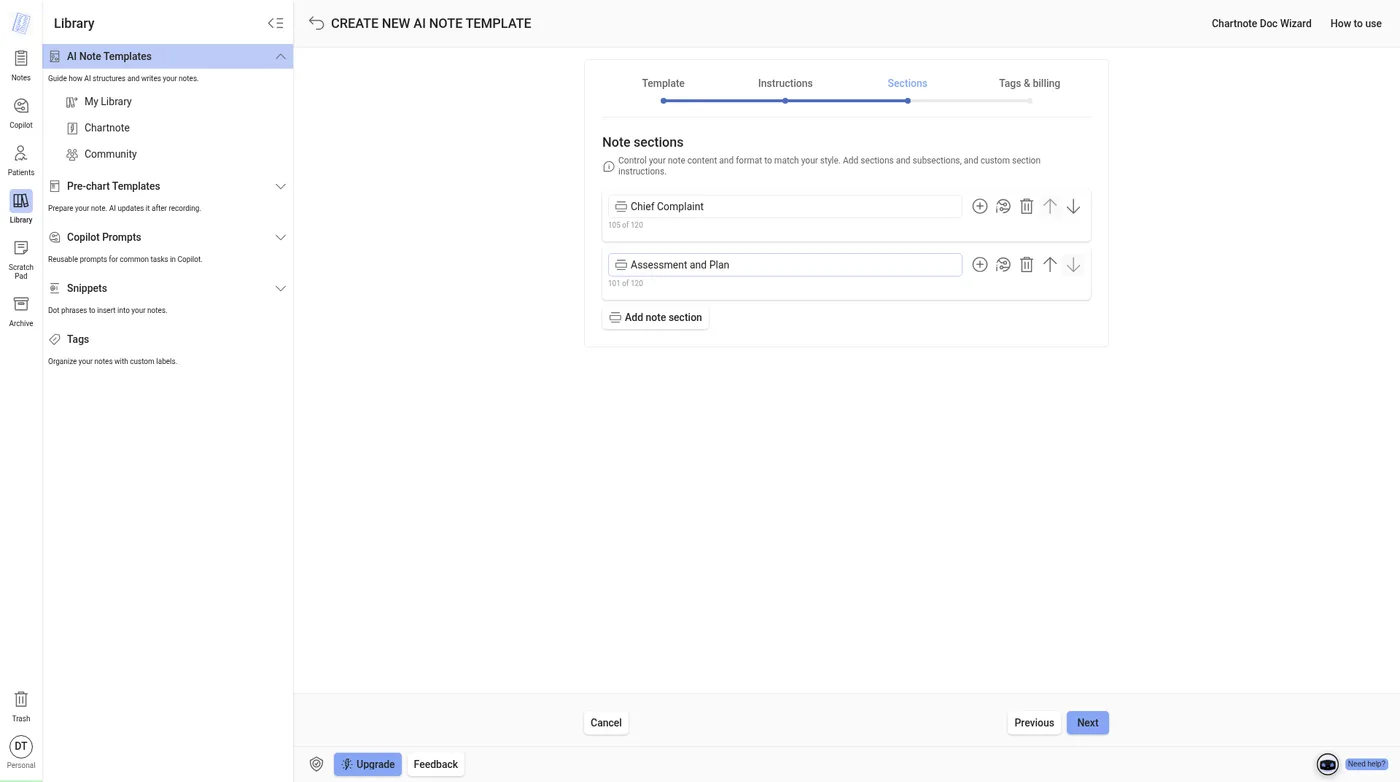
A template tells the AI scribe how to write, not just what to include. A few principles that make a big difference:
- Define your sections and subsections. For example: A&P by problem, or a systems-based assessment for complex patients.
- Set the style. Narrative HPI, bullet-point plan, or concise everything.
- List your abbreviations. If you write “HEP” or “ATFL,” tell the template so notes match your voice.
- Add specialty fields. Minutes by intervention (PT), lesion counts (derm), risk scores (cardiology), standardized scales (behavioral health).
- Use snippets for repeated text. Education handouts, return precautions, or procedure consent language.
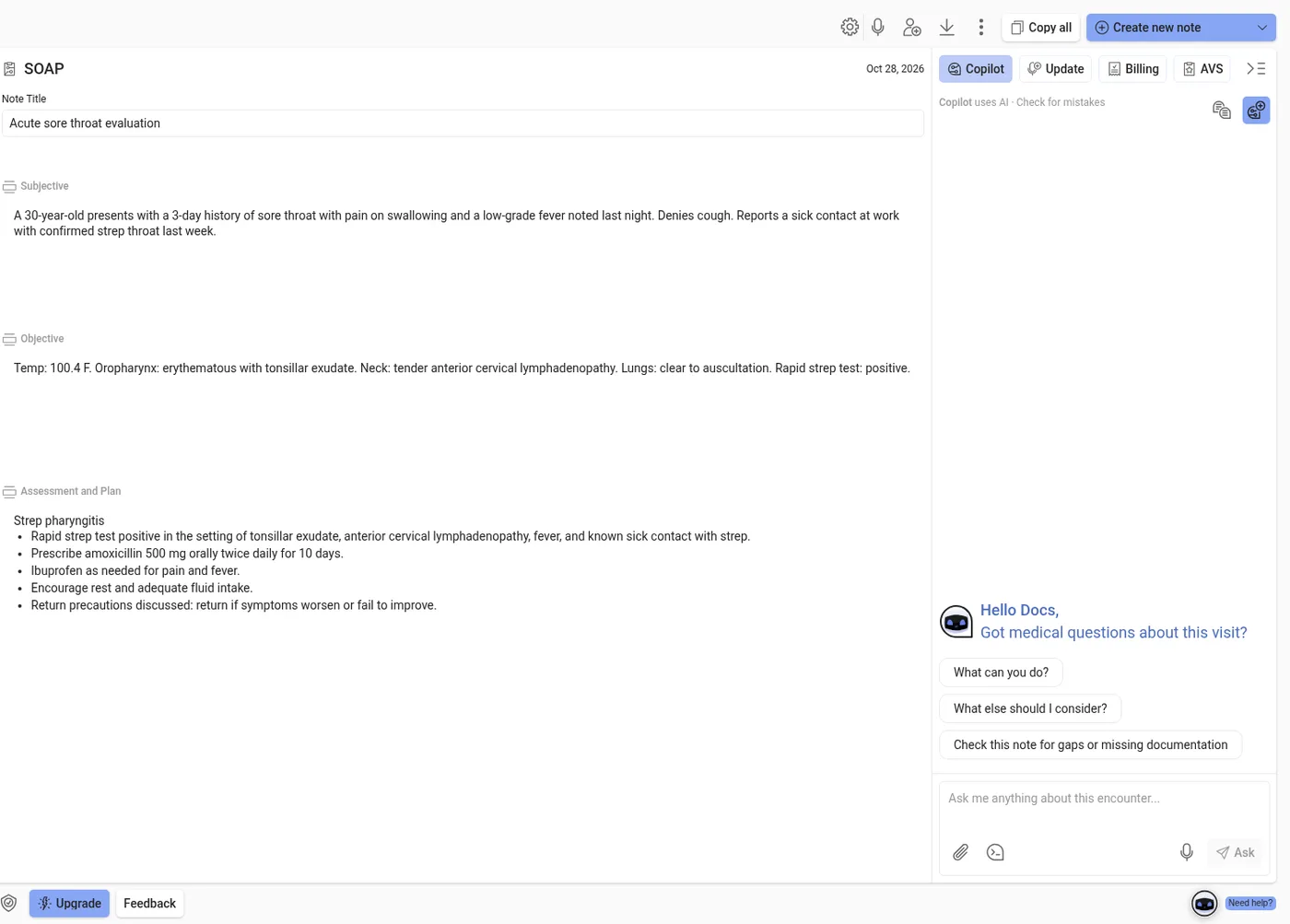
In Chartnote, you can create custom AI note templates with your own sections, nested subsections, and writing instructions, and they apply automatically when you record with AI Scribe or dictate with Voice Chart. Here’s how Custom AI Note Templates work. Chartnote also comes with more than 1,000 preloaded templates and a community library, plus snippets for dot phrases.
Tips for better AI-generated SOAP notes
- Say exam findings out loud. The scribe can only document what it hears.
- Summarize your plan before the patient leaves. It helps the patient, and it gives the scribe a clean plan.
- Review every note. Check for omissions, wrong laterality, and anything documented that didn’t happen.
- Refine your template after a week. Note what you keep editing and add an instruction for it.
- Use billing suggestions as a starting point. Chartnote suggests ICD-10, CPT, and E/M codes, but final coding is your call.
FAQ
What is a SOAP note?
A SOAP note is a structured clinical note with four sections: Subjective, Objective, Assessment, and Plan. It’s one of the most widely used documentation formats across medicine, therapy, and allied health.
Can AI write SOAP notes?
Yes. AI scribes listen to the visit and draft a SOAP note for the clinician to review, edit, and sign. The clinician remains responsible for the final note.
Are AI-generated SOAP notes accurate?
They can be very good, but accuracy depends on the tool, the template, and audio quality. Always review for omissions, errors, and findings that weren’t actually part of the visit.
Can I use the same SOAP template for every specialty?
You can, but you’ll get better notes with specialty-specific templates. A PT note needs minutes and functional measures; a dermatology note needs lesion detail; a therapy note may use DAP or BIRP instead.
Does Chartnote support formats other than SOAP?
Yes. Chartnote’s custom AI templates let you define your own sections and subsections, so you can build SOAP, problem-based, systems-based, or other formats.
Try AI SOAP notes on your next visit
Pick a template for your specialty, record a visit, and see what your draft looks like in seconds. Start free with 15 AI Scribe notes a month at chartnote.com/welcome.
Setting up templates for a whole practice? Book a demo and we’ll help you build them.